Soft, Fluffy, and Unpredictable: The Nature of Brushed Yarns and Fit Variation

Brushed‑yarn knitwear has a charm that few other textiles can match. The airy halo, the soft‑focus surface, the gentle warmth and loft, all of these qualities make brushed garments feel luxurious, cosy, and visually distinctive. Yet anyone developing brushed knitwear for the first time quickly discovers a less romantic truth: these pieces are notoriously difficult to measure, control, and reproduce with precision.
Understanding why brushed yarn behaves this way is essential for designers, brands, and newcomers to knitwear development. The softness you want is the very thing that makes consistency harder to achieve. A realistic grasp of the material’s nature helps set expectations, avoid unnecessary disputes, and design garments that work with the fibre rather than against it.

The nature of brushed yarn
Brushed yarn is created by mechanically raising fibres from the yarn surface, producing a halo. This halo is what gives brushed knitwear its softness and visual depth, but it also introduces structural instability.
Key characteristics include:
Loft and air content — The brushing process traps air within the yarn structure, making the fabric lighter, fluffier, and less dense.
Reduced stitch definition — The halo obscures the underlying stitches, which makes the fabric appear fuller but also less structurally “fixed.”
Higher elasticity and compression — The raised fibres compress easily under pressure and expand again when released.
Greater sensitivity to handling — Stretching, steaming, pressing, or even folding can temporarily change the garment’s dimensions.
These properties are desirable aesthetically, but they come with technical consequences.
Why measurements are difficult to control
Brushed knitwear does not behave like compact, smooth yarns. Several factors contribute to measurement variability:
Halo compression — When the garment is laid flat, the halo compresses, making the piece appear smaller. When lifted or worn, the halo expands, making it appear larger.
Fabric relaxation — Brushed yarn relaxes slowly after knitting. Measurements taken immediately after knitting, after washing, and after a few days of rest can all differ.
Inconsistent tension during handling — Even slight differences in how the garment is placed on a table can change the measured width or length.
Environmental sensitivity — Humidity, temperature, and steam exposure affect loft and stretch.
Gauge instability — The brushing process can loosen the knit structure, making the fabric more prone to stretching during wear or production.
The result is that two garments knitted to the same specifications may still show small but noticeable differences in finished measurements.
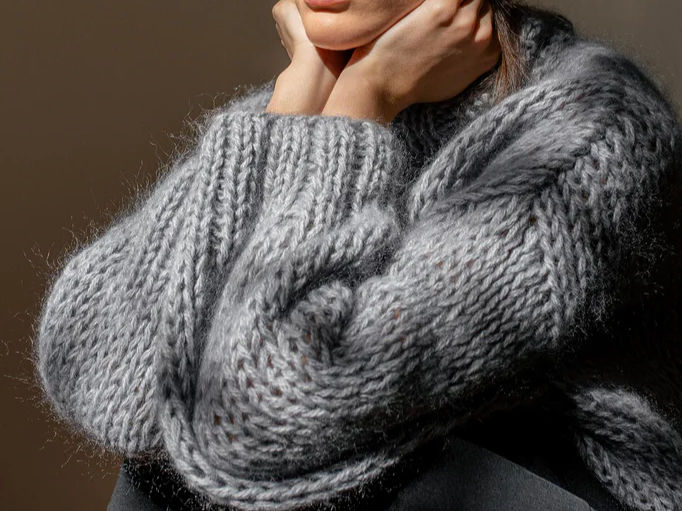
What brushed yarn can achieve
Brushed yarn excels in areas where softness, comfort, and visual texture are the priority.
A luxurious, airy hand‑feel The halo creates a gentle, cloud‑like surface that feels premium and comforting.
A flattering, diffused appearance The soft surface hides minor irregularities and gives garments a romantic, slightly blurred look.
Lightweight warmth The trapped air provides insulation without heaviness.
A premium aesthetic Brushed knitwear often reads as more elevated and fashion‑forward.
For brands aiming for softness, warmth, and a relaxed silhouette, brushed yarn is an excellent choice.
What brushed yarn cannot achieve
There are limitations that no factory, yarn supplier, or technician can fully overcome.
Perfect measurement precision Expecting exact, repeatable measurements to the millimetre is unrealistic. A tolerance range is essential.
Sharp stitch definition The halo will always obscure the knit structure.
Rigid, structured silhouettes Brushed yarn naturally drapes and relaxes; it cannot hold crisp lines.
High stability under wear Over time, brushed garments may grow slightly in length or width due to the loosened structure.
Uniform appearance across batches Even with the same yarn lot, brushing intensity and fibre behaviour introduce natural variation.
Understanding these limitations helps prevent disappointment and ensures the design aligns with the material’s nature.

Pros and cons for new developers
A balanced view helps newcomers decide whether brushed yarn suits their collection.
Pros
Soft, premium hand‑feel
Lightweight warmth
Fashionable, cosy aesthetic
Forgiving surface that hides minor irregularities
Ideal for relaxed silhouettes
Cons
Measurement variability
Lower structural stability
More sensitive to handling and finishing
Harder to achieve exact colour matching due to halo reflection
Requires realistic tolerance expectations
Brushed yarn is not “worse” than smooth yarn — it is simply different, and it demands a different mindset.
Setting realistic expectations for development
Brands new to brushed knitwear often assume it will behave like compact yarns. A smoother yarn can be measured with high precision; brushed yarn cannot. To avoid misunderstandings, it helps to adopt the following expectations:
Allow measurement tolerances A tolerance of ±2–3 cm is normal for brushed garments, depending on gauge and style.
Expect slight differences between samples and bulk Brushing intensity and yarn relaxation vary.
Avoid overly fitted designs Brushed yarn is best suited to relaxed or semi‑fitted silhouettes.
Approve colour from physical swatches The halo affects how light reflects, so digital references are unreliable.
Handle samples gently Stretching or pressing can distort measurements temporarily.
These practices ensure smoother communication and more predictable outcomes.
A practical guide for clients developing brushed knitwear
For those entering this category, a few principles make the process far easier:
Choose designs that suit the yarn Relaxed jumpers, cardigans, and soft accessories work best.
Review physical colour cards The halo changes the perceived shade; digital codes cannot replicate this accurately.
Discuss tolerance ranges early Agreeing on acceptable measurement variation prevents disputes later.
Allow garments to rest before measuring Letting the fabric relax for 24–48 hours gives a more stable reading.
Expect natural variation Brushed yarn is inherently organic in behaviour; perfection is not the goal.
Approaching development with these principles in mind leads to better results and a more enjoyable process.
Brushed yarn knitwear is beloved precisely because it is soft, airy, and full of character. Those same qualities make it unpredictable, and no amount of technical skill can fully eliminate its natural variability. When designers and clients understand this, they can appreciate brushed knitwear for what it truly is: a material that rewards flexibility, embraces softness, and delivers a uniquely luxurious experience.


Comments